

Learn These Five River Skills And Permanently Change How You Paddle

The Key To Safety On The River Is To Control Your Kayak Or The River Will Control You
Published © March 2026 by CanoeSport Outfitters | Est. 1992 | 34 Years Serving Iowa Paddlers
There's a certain magic to drifting down an Iowa river on a warm afternoon — paddle across your lap, sun on your face, letting the current do the work. It's one of the simplest pleasures paddling has to offer, and on most Iowa waterways, that laid-back approach works just fine. The rivers are gentle, the currents forgiving, and the biggest decision you'll face is whether to stop for lunch before or after the next bend.
But step into a faster river, encounter higher water levels after heavy rain, or find yourself bearing down on a logjam with nowhere to go, and that same carefree attitude can turn a good day sideways in a hurry. The difference between a paddler who handles those moments confidently and one who doesn't usually comes down to a handful of skills that go beyond basic forward strokes — techniques that put you in conversation with the river rather than just along for the ride.
Think of these as your next-level toolkit. None of them require whitewater experience or a heroic amount of athleticism. What they do require is a willingness to slow down, practice deliberately, and start paying attention to what the water is doing beneath and around your boat. Master these five skills and you won't just be safer on the water — you'll find that paddling becomes a lot more interesting.
Skill One: Edging — Let the Hull Do the Work
Before you can truly work with a river, you need to understand your own boat. Most paddlers sit upright and treat their kayak like a flat platform. Edging changes that relationship entirely.
Edging means intentionally tilting your kayak to one side by lifting one knee while pressing down with the opposite hip — tipping the boat while keeping your upper body relatively balanced over the water. This does two things. First, it shortens the effective waterline of the hull. A shorter waterline means less resistance, and less resistance means the boat pivots more easily. Second, it allows water pressure against the angled hull to actually assist your turn rather than fight it. On edge a kayak has a long side and a short side rather than two sides that are equal. The long side will have less pressure against it since the water has further to travel. Your kayak will naturally want toward the reduced pressure.
How to practice: Find calm, shallow water and practice tilting your boat progressively further to each side. Get comfortable with how far you can edge before you feel unstable. Then combine a light edge with a sweep stroke and notice how much more efficiently the boat responds. Most paddlers are surprised how much easier turning becomes once edging clicks.
A critical safety note: on moving water, the instinct when approaching an obstruction is to lean away from it — which raises the upstream edge and lets water pour in. The correct move is to edge into the obstruction, dropping the upstream knee and presenting the hull rather than the rim to the moving water. If you can’t avoid it, hug it; lean into it. It feels counterintuitive until it doesn't and practicing it in calm water builds the muscle memory before it matters.
Skill Two: Reading the River — The Water Is Telling You Something
A river is not a uniform conveyor belt. It's a constantly shifting system of features, each one with its own personality and its own implications for your safety and your route. Learning to read those features before you're on top of them is one of the most valuable skills in paddling.
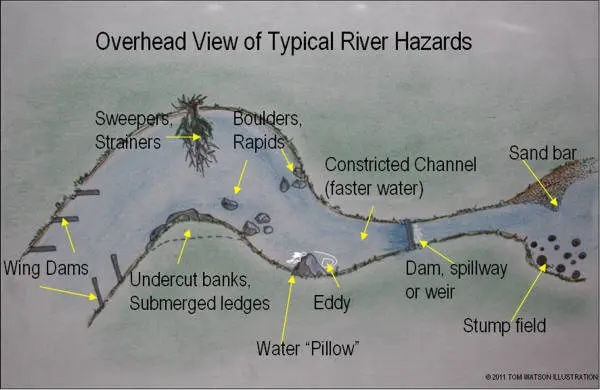
Eddies are the calm, often upstream-flowing pockets of water found behind rocks, bridge pilings, fallen trees, and points of land. Where the main current rushes past an obstruction, it creates a low-pressure zone on the downstream side. Water fills that zone, often circling back upstream. Eddies are rest spots, observation points, and parking places on a moving river — your best friends when you need a moment to scout what's ahead.
The eddy line is the boundary between the eddy and the main current. It's not always visible, but it's always there, and crossing it intentionally in fast moving water is a skill of its own (more on that in a moment).
Holes (also called hydraulics) form where water drops over a ledge or submerged rock and the surface water recirculates back upstream at the base. From upstream they often look like a smooth V-shaped tongue of water leading to a foamy trough. Small holes are playful features; large holes can be powerful enough to hold a boat — or a swimmer — in recirculation. Learn to identify them from shore before committing your line.
Strainers are arguably the most dangerous feature on an Iowa river — and one of the most common. A strainer is any obstruction (typically a downed tree or logjam) that allows water to pass through but traps solid objects like kayaks and people. The current pushes relentlessly against whatever gets pinned there. On Iowa's tree-lined rivers, strainers can appear around any bend, especially after storms. When you see one, your job is to be well clear of it — which is exactly what the next three skills help you do.
Reading water also means understanding current lanes. The fastest water is typically in the deepest channel, often (but not always) near the outside of bends. Shallower water near the inside of bends moves more slowly. Upstream-pointing V-shapes on the surface usually indicate clear channels; downstream-pointing V-shapes often signal a submerged obstruction.
Make it a habit: Before every trip, scout from shore whenever possible. On the water, keep your eyes 50 to 100 yards ahead, not on your bow. The river will tell you where it's going — you just have to learn the language.
Skill Three: Eddy Turns — Finding the Safe Zone
Now that you can read eddies, it's time to use them. An eddy turn is the technique for moving your kayak from the main current into an eddy — crossing that eddy line and coming to rest in calm water facing upstream.

The physics here are worth understanding. As your bow crosses the eddy line, it enters water that is moving in the opposite direction (or much slower) than your stern, which is still in the current. That difference in water speed wants to spin the boat. Your job is to use that spin rather than fight it.
The sequence: approach the eddy from upstream at an angle of roughly 30 to 45 degrees, paddle forward with enough speed to punch the eddy line, plant a forward sweep or a draw stroke on the upstream side as your bow crosses the eddy line, present the bottom of your kayak to the moving water (which in an eddy is flowing back upstream), to help the hull swing around. Done well, the current does most of the turning work and you glide to a stop in calm water facing upstream, exactly where you wanted to be.
Why it matters: Eddies give you control over your pace and your position on the river. Instead of being carried helplessly toward the next feature, you can stop, look, rest, regroup, and choose your moment to re-enter. On a strainer-heavy Iowa river, that ability to pause and assess is not a luxury — it's a safety skill.
Skill Four: Peel Outs — Rejoining the River on Your Terms
The peel out is the eddy turn in reverse — leaving the calm of an eddy and re-entering the main current. It's equally important, because an eddy you can get into but can't get out of in a controlled way isn't very useful.
Starting from within the eddy, facing upstream, you paddle forward toward the eddy line at an angle. As your bow crosses into the current, it encounters faster-moving water while your stern is still in the slow eddy water. Again, the river wants to spin you — this time in the opposite direction from an eddy turn. Edge away from the current, plant a forward stroke or low brace on the downstream side, and let the current complete the turn, sweeping you downstream in the direction you want to go.
A key mistake beginners make on peel outs is hesitating at the eddy line — half in, half out, getting spun sideways and broadside to the current. Commitment is the answer. Cross the line with purpose, edge decisively, and trust the water to finish the turn.
If eddy turns and peel outs sound confusing, just remember the most important thing in moving water is to always present your hull to the moving water. Getting into the eddy requires leaning or edging upstream. Peeling out and getting back into the current requires leaning or edging downstream.
Eddy turns and peel outs practiced together form a complete circuit — in, out, in, out — and doing this deliberately on an easy stretch of river is one of the best ways to build confidence and fluency with moving water.
Skill Five: The Ferry — Your Best Tool for Avoiding Trouble
If you learn only one skill from this list for practical river safety, make it the ferry. It is the single most useful technique for avoiding obstacles and navigating a river deliberately.
Ferrying is the art of moving your kayak laterally — left to right or right to left — across a current without moving downstream. The idea is elegantly simple: by angling your bow or stern upstream and paddling against the current, you use the current pushing against the angled hull to drive you sideways across the river while your paddling momentum counters the downstream flow. Adjust your angle to control the balance between lateral movement and downstream drift.
Here's the principle that makes it worth understanding deeply: speed on a river without control only delivers you to trouble faster. A paddler who is charging downstream without the ability to reposition laterally is at the mercy of whatever the river puts in their path. A paddler who can ferry can thread between obstacles, work across to a better current lane, or set up the perfect angle for an eddy turn — all while maintaining position.
Forward ferry: Facing upstream, angle your bow roughly 20 to 45 degrees toward the side you want to move toward, and paddle forward. More angle means more lateral movement but also more downstream drift. Less angle is slower but more controlled. Practice finding the sweet spot for different current speeds.
Back ferry: Same principle, but facing downstream and paddling backward. Of the two it’s the most important to learn because you won’t often have time to spin your kayak. You see something you don’t want to get closer to you start to back paddle. When your speed matches the speed of the current, you’ll stop moving downstream. Now let your stern start to point toward the shore you want to move to and the current will push you that way without moving downstream. Many paddlers find this more intuitive at first because you can see where you're going. It's particularly useful for buying time when something unexpected appears ahead or you're starting to drift past your exit!
On Iowa rivers with overhanging trees, narrow channels, and seasonal strainers, the ferry may be the move that keeps you out of a very bad situation. Practice it every time you're on the water — even on calm sections — so that when you need it, it's automatic.
Putting It Together
These five skills don't exist in isolation. A confident river paddler uses them fluidly, often in combination: reading a strainer ahead, ferrying to a better position, dropping into an eddy to scout the cleanest line, then peeling out with a clean edge to continue downstream. The river becomes less of a force to survive and more of a medium to move through intentionally.
Iowa's rivers are a perfect classroom. They're accessible, mostly forgiving, and just varied enough to give you real situations to practice in. Find a stretch with a few mild features — a gravel bar that creates a bit of current, a bridge piling with an eddy behind it — and spend a morning working through these techniques deliberately. You'll be surprised how quickly they start to feel natural.
And the next time the water comes up after a heavy rain and that familiar stretch looks a little different, a little faster, a little less forgiving — you'll be glad you did.

CanoeSport Outfitters | “Where Paddling Is A Priority”
Phone: 515-961-6117 or 515-339-5582 | Email: info@canoesportoutfitters.com
Check out www.canoesportoutfitters.com for more about our retail store, our rental facilities at Lake Ahquabi State Park & Raccoon River Park, and our full schedule of Instruction Programs and Adventure Trips.


Comments